
 german
 english
Axial Ball Bearings
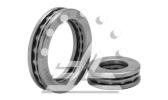
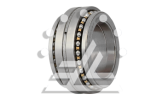
Axial ball bearings are special rolling bearings designed primarily to absorb axial forces. These forces act along the shaft axis and are also known as thrust forces. Unlike radial ball bearings, which support lateral loads, axial ball bearings are specifically designed for this type of load. They consist of balls that are guided between two raceways. This results in minimal friction, enabling smooth operation and a long service life—even under high loads.
The operating principle is simple and efficient: The balls roll smoothly between the rings, ensuring reliable force transmission in the axial direction. At the same time, wear is reduced. Thrust ball bearings are available in various designs. There are single-direction bearings that absorb forces from one direction, as well as double-direction variants for loads from both directions. This allows them to be used flexibly in a variety of applications.
In practice, axial ball bearings are used in many applications. In the automotive industry, for example, they are used in steering systems, clutches, and drivetrains. They also play an important role in electric mobility, as they contribute to quiet and efficient operation. Furthermore, they are widely used in mechanical and plant engineering, for example in pumps, gearboxes, presses, or machine tools. There, they support shafts and spindles in absorbing axial forces and ensure trouble-free operation.
A major advantage of axial ball bearings is their high load-carrying capacity combined with a compact design. This makes them suitable even for tight installation spaces. They are also low-maintenance, durable, and reliable. Thanks to the combination of low friction, high load capacity, and precise operation, axial ball bearings are a cost-effective solution for many industrial applications and have become indispensable in modern technology.
{{group.name}}
{{group.name}}
{{group.name}}